Keder types refer to the flap or attachment construction surrounding the keder bead, with the primary configurations including single flap, double flap, welded flap, and repair keder. For tent and structure fabricators, choosing the right type is important because the construction affects how the keder attaches to the fabric, the welding technology required, and how the finished seam performs in its intended application.
Principaux enseignements
- Keder type refers to the flap or attachment construction, while keder size refers to bead diameter. These are separate specifications.
- Single flap keder attaches to one side of the fabric and offers flexibility in welding technology, including hot air, hot wedge, and RF.
- Double flap keder sandwiches the fabric between two flaps to distribute load across a wider area and is generally associated with RF welding for full multi-layer fusion.
- Welded flap keder uses a pre-welded PVC flap that is then sewn to the finished fabric, while repair keder is intended for retrofit and maintenance applications.
- Choosing keder should involve both the finished application's requirements and the welding or fabrication equipment available to produce it.
What Are Keder Types?
Keder types describe the construction used to connect the keder bead to the finished fabric or panel. The primary configurations include single flap, double flap, welded flap, and repair keder.
Understanding these differences is important because keder construction can affect load distribution, fabrication methods, equipment selection, and the finished product.
Keder Type Means Flap Construction, Not Size
Keder type and keder size are two different specifications.
The type describes how the flap or attachment is constructed around the bead and connected to the finished material. The size generally refers to the diameter of the bead that will fit into the corresponding keder rail or track.
For example, two keder products may use the same bead diameter but have different flap configurations. One could be a single flap product while the other uses a double flap construction.
Fabricators therefore need to determine both the appropriate construction and the appropriate bead size for their application.
Why Keder Type Affects Your Welding Process
The flap construction determines how the keder will be attached and which fabrication technology can be used.
A single flap configuration creates a relatively straightforward attachment point and provides more flexibility in the welding method. Double flap construction involves multiple material layers and may require a welding technology capable of creating consistent fusion through the complete assembly.
Material compatibility is equally important. Before establishing a process, manufacturers should confirm that their weldable industrial fabrics are compatible with the chosen welding technology.
Single Flap Keder: What It Is and Where It Works Best
Single flap keder uses one flap extending from the keder bead to provide an attachment point for the finished fabric.
Its relatively simple construction makes single flap keder a versatile option for many applications and fabrication processes.
How Single Flap Keder Attaches to Fabric
The flap is positioned against the edge of the fabric and attached using an appropriate welding or sewing process. Once installed, the bead can slide into a compatible keder rail or track, creating a secure edge connection.
Because the attachment occurs on one side of the bead, single flap keder is useful when the application does not require the fabric to be captured between two opposing flaps.
Which Welding Methods Work for Single Flap Keder?
One of the primary advantages of single flap keder is its flexibility in fabrication.
Depending on the material and construction, single flap keder can be processed using hot air welding equipment, hot wedge systems, or RF welding.
Hot air uses heated air at the weld interface before pressure is applied to create the seam. Hot wedge uses a heated wedge positioned between the material layers, followed by pressure rollers. RF welding uses electromagnetic energy to heat compatible materials internally.
The correct process depends on the keder material, finished fabric, seam configuration, and production requirements.
Best Industrial Applications for Single Flap Keder
Single flap construction can be useful for applications such as:
- Auvents et marquises
- Signage and banners
- Lighter-duty tent components
- General fabric panels using a one-sided attachment
- Applications with moderate tension requirements
Double Flap Keder: Why Welding Technology Matters
Double flap keder uses two flaps to capture the adjoining fabric between them, distributing the attachment across a wider area.
This construction can be valuable for applications where greater load distribution is required.
How Double Flap Keder Sandwiches Fabric
With double flap keder, the finished fabric is positioned between two flap sections. Rather than attaching the material from only one side, the configuration creates an attachment on both sides of the fabric.
This can distribute forces over a wider area, making double flap construction useful for applications involving greater tension or structural loads.
Actual seam performance depends on multiple factors, including the material, bead size, fabric weight, weld configuration, and welding process.
Why Double Flap Keder Is Commonly Associated With RF Welding
Full double flap construction creates a more complex multi-layer welding requirement than a single flap seam.
Radio frequency welding technology can be well suited to compatible multi-layer assemblies because RF energy generates heat within the material itself rather than relying solely on heat applied at the surface.
For this reason, RF is commonly used when full multi-layer fusion is required for double flap keder.
Hot air and hot wedge welding can still be appropriate for certain overlap configurations depending on the design and material. However, fabricators should not assume that a process used successfully for single flap keder will automatically produce the same result on a double flap configuration.
Testing the actual material and keder construction is important before establishing production parameters.
Best Applications for Double Flap Keder
Double flap keder can be suited to applications such as:
- Tent and structure sidewalls
- Roof panel connections
- Industrial curtains and partitions
- Bâches
- Couvertures de piscine
- Other tensioned fabric products requiring greater load distribution
Welded Flap and Repair Keder: Other Important Configurations
Single and double flap are not the only keder configurations fabricators may encounter. Welded flap and repair keder address different production and maintenance requirements.
Welded Flap Keder: Pre-Welded for Sewn Installation
Welded flap keder can cause some confusion because the word "welded" does not necessarily describe how the fabricator attaches it to the finished product.
In this configuration, a PVC flap is pre-welded during the keder manufacturing process. The finished flap can then be sewn onto the fabric during fabrication.
This approach allows manufacturers that rely primarily on sewing equipment to incorporate a PVC keder attachment into their products without having to weld the keder directly onto the finished panel.
Welded flap configurations can be useful in applications such as marine fabrication, awnings, screens, and other products where sewing remains part of the established production process.
Repair Keder: Restoring an Existing Attachment
Repair keder is intended for retrofit, service, or refurbishment applications.
Rather than replacing an entire fabric panel because the existing keder attachment is damaged, repair keder can provide a way to restore the attachment area.
The exact repair procedure depends on the original construction. The replacement should be selected with the original bead size, material, attachment method, and finished application in mind.
Single vs. Double vs. Repair Keder: Which Type Do You Need?
Choosing among keder types starts with understanding what the finished product needs to accomplish. Load requirements, fabrication equipment, installation method, bead size, production volume, and the right combination of keder construction, bead size, and rail compatibility should all be considered.
| Keder Type | Flap Construction | Compatible Fabrication Methods | Idéal pour | Relative Strength |
|---|---|---|---|---|
| Single Flap | One flap on one side of bead | Hot air, hot wedge, or RF depending on material | Awnings, canopies, signage, banners | Standard |
| Double Flap | Two flaps capture fabric | RF commonly used for full multi-layer fusion; other configurations may vary | Tents, structures, curtains, higher-load panels | Haut |
| Welded Flap | Pre-welded PVC flap, then sewn | Sewing during final fabrication | Marine, screens, awnings | Standard–High |
| Repair | Retrofit attachment | Depends on original construction | Maintenance and refurbishment | Variable |
How to Choose the Right Keder Type for Your Production Line
Keder selection should not be treated only as a component decision. It is also a production decision.
A keder specification that looks appropriate for the finished product still needs to work with the manufacturer's materials, welding technology, and production requirements.
Step 1: Confirm the Application and Load Requirements
Begin with the finished product.
A lighter-duty awning attachment may have very different requirements from a large tent sidewall or tensioned structure panel. Consider the forces placed on the attachment, environmental exposure, installation method, and expected service conditions, along with the supporting frame; keder rails are usually made from aluminum or steel, so both should suit the service conditions.
These requirements help determine whether a single flap, double flap, welded flap, or repair configuration is appropriate.
Step 2: Match Keder Type to Available Welding Technology
Next, evaluate how the keder will actually be attached.
If your production operation uses hot air or hot wedge equipment, single flap keder may provide more processing flexibility. If your product requires a full multi-layer double flap construction, RF technology may be a better fit depending on the materials and seam design.
Understanding these differences before specifying the keder can prevent a situation where the required construction does not match the capabilities of the available equipment.
For a deeper look at these processes, see our guide to comparing hot air and RF welding.
Step 3: Size the Keder Bead and Fabric Weight Separately
After determining the appropriate keder construction, confirm the bead size required by the rail or track. As a sizing note, the rail opening is typically about 60–70% of the rope diameter. When the fit is correct, the keder should slide into the rail channel with hand pressure.
Remember that keder type and keder size are independent specifications. A double flap construction does not automatically dictate one bead diameter, just as a particular bead diameter does not determine whether single or double flap should be used.
Material weight and thickness should also be considered when developing the final welding process.
Step 4: Select Equipment for Your Production Requirements
The final consideration is production.
Ask how frequently keder will be produced, what other seams need to be completed, what materials are being processed, and what level of automation is required.
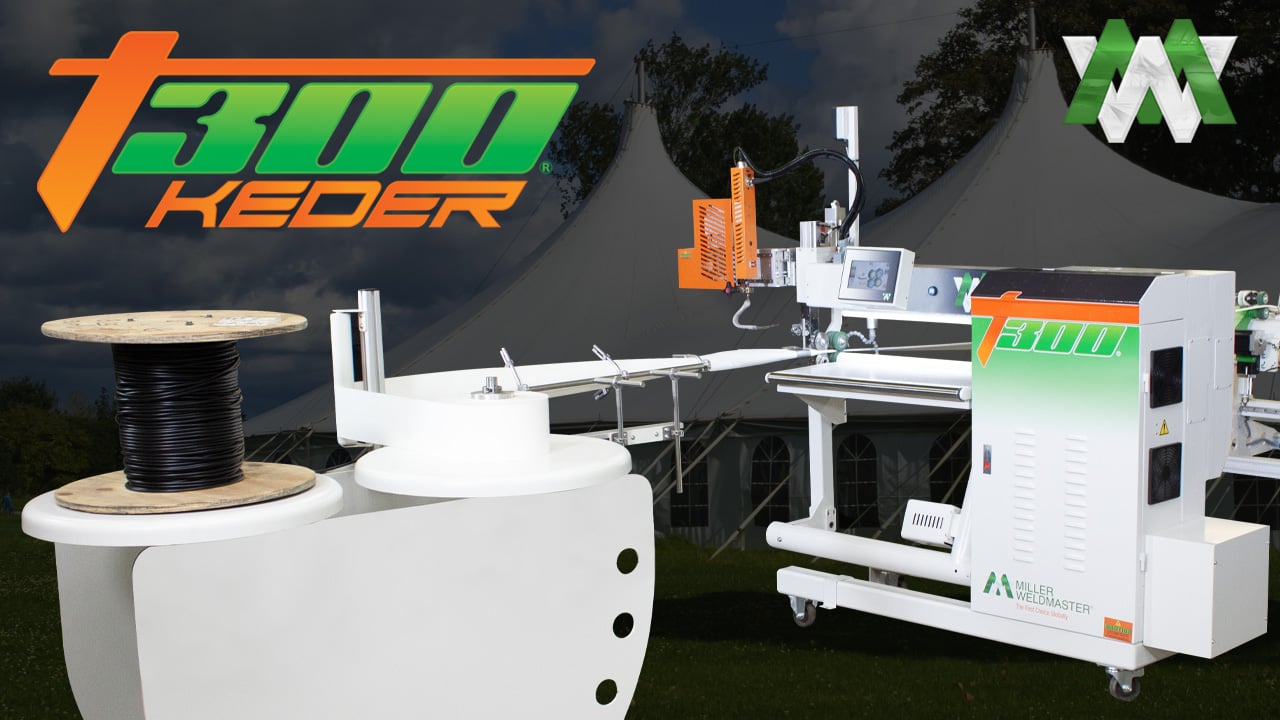
Miller Weldmaster offers equipment for a variety of keder and fabric-finishing applications. The T300 Extreme Keder system is designed around keder production, while the M100 keder welder provides additional fabric-finishing capabilities for applications requiring multiple seam types.
The right machine should ultimately be selected based on the specific keder configuration, material, required weld, and production goals.
| Keder Type | Application type | Welding/Fabrication Technology | Equipment Consideration |
|---|---|---|---|
| Single Flap | Awnings, banners, lighter-duty panels | Hot air, hot wedge, or RF depending on material | Choose equipment based on seam geometry and volume |
| Double Flap | Tent structures and higher-load panels | RF commonly used for full multi-layer fusion | Confirm machine and tooling with actual keder construction |
| Welded Flap | Marine, awnings, screens | Pre-welded flap; sewn during fabrication | Standard sewing process during final attachment |
| Repair | Maintenance and refurbishment | Match original construction | Evaluate existing bead, fabric, and attachment method |
Common Mistakes When Selecting a Keder Type
Understanding the differences between keder configurations can help prevent production problems before material reaches the welding machine.
Mistake 1: Specifying Double Flap Without Confirming Welding Capability
Selecting double flap keder for increased load distribution without first evaluating the welding process can create manufacturing challenges.
A manufacturer may discover that equipment used for single flap production is not configured to produce the required multi-layer double flap seam.
Confirm the welding technology, material compatibility, tooling, and seam requirements before finalizing the keder specification.
Mistake 2: Confusing Keder Type With Keder Size
Bead diameter and flap construction solve different problems.
The bead must fit the required rail, while the flap construction must suit the attachment and fabrication process. Selecting one does not automatically determine the other.
Treat both as separate specifications during product development.
Mistake 3: Assuming All Repair Keder Matches the Original Installation
A repair component should be selected around the construction it is replacing.
Differences in bead diameter, material, attachment configuration, or fabrication process can complicate a repair and potentially affect the performance of the finished panel.
Documenting the original construction makes future service and replacement considerably easier.
How Miller Weldmaster Supports Keder Production
Keder production requirements can vary considerably between tent, awning, marine, signage, fabric structures, and industrial fabric applications. That is why equipment selection should begin with the product being manufactured rather than simply choosing a welding technology first.
Miller Weldmaster offers hot air, hot wedge, and RF welding technologies for a wide range of industrial fabric applications and industrial applications. This allows manufacturers to evaluate the welding process that best matches their keder construction, materials, seam requirements, and production volume.
Fabricators can also explore how keder is manufactured step by step or learn more about our awning, shade, and marine equipment.
Whether you are developing a new product, increasing production volume, or evaluating a different keder configuration, testing the actual materials and attachment design can help determine the right process before production begins.
Talk to a Miller Weldmaster specialist to discuss your keder application and determine which welding technology and equipment configuration best fits your production needs.
Frequently Asked Questions About Keder Types
What are the different types of keder?
The main keder types include single flap, double flap, welded flap, and repair keder. The type refers to how the attachment or flap is constructed around the bead rather than the bead's diameter.
What is the difference between single flap and double flap keder?
Single flap keder provides an attachment on one side of the bead. Double flap keder uses two flaps to capture the adjoining fabric, helping distribute loads over a wider attachment area. Single flap construction also offers greater flexibility in welding technology, while full multi-layer double flap construction is commonly associated with RF welding.
Does double flap keder require RF welding?
RF welding is commonly used for full multi-layer double flap keder construction because it can generate heat within compatible materials throughout the weld area. The appropriate method ultimately depends on the material and seam configuration, and certain simpler overlap configurations may be possible with other welding technologies.
What keder type and keder rail are best for tents and structures?
The appropriate keder depends on the specific attachment and load requirements. Double flap construction can be useful for tent and structure applications requiring greater load distribution, while single flap keder can work well for lighter-duty attachments and other components.
What keder type is best for marine applications?
Welded flap keder can be useful in marine applications because the PVC flap is pre-welded during manufacturing and can then be sewn to the finished fabric. The correct configuration depends on the particular marine product, installation, and load requirements, and corrosion-resistant material choices are especially important in marine environments.
How do I choose the right keder type for my project?
Start with the application and load requirements, then determine which attachment construction meets those needs. Next, confirm that your welding or sewing equipment can process that construction. Finally, select the bead diameter and material specifications required for the rail system or keder rail systems and finished product.
What is repair keder used for?
Repair keder is used to restore or replace an existing keder attachment during maintenance or refurbishment. The replacement should be selected to match the original bead size, material, and attachment method as closely as practical.