How to choose a hot air welding machine comes down to three things: the materials you weld, the seams you need, and how much you produce. The right machine joins thermoplastic fabrics with strong, watertight seams and no thread or glue. Miller Weldmaster builds industrial hot air welding machines for everything from banners and tarps to inflatables and roofing membranes.
This buyer's guide explains what a hot air welding machine does, how it handles vinyl and other thermoplastics, and the questions to answer before you choose one.
Dans ce guide :
- What is a hot air welding machine?
- Benefits of hot air welding machines
- Hot air welding for vinyl and thermoplastics
- How to choose the right hot air welding machine
- When is hot air welding the right choice?
- Hot air welders from Miller Weldmaster
- Foire aux questions
Qu'est-ce qu'une machine à souder à air chaud ?
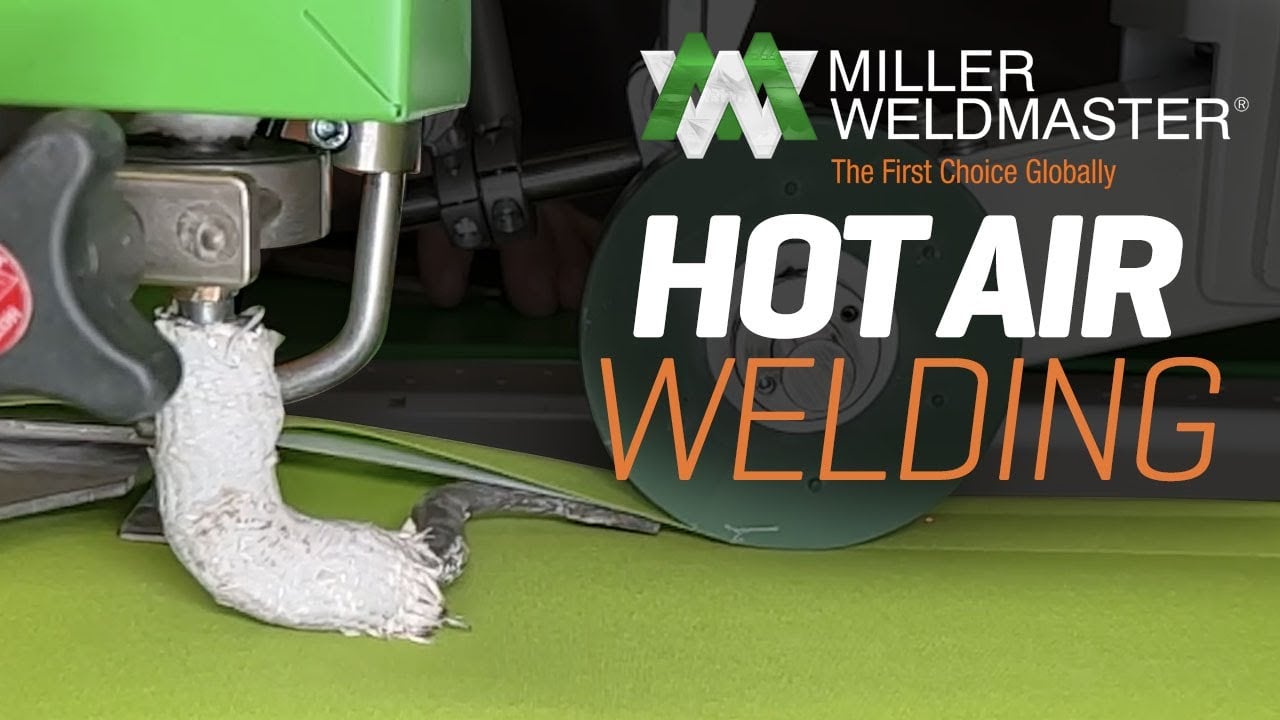
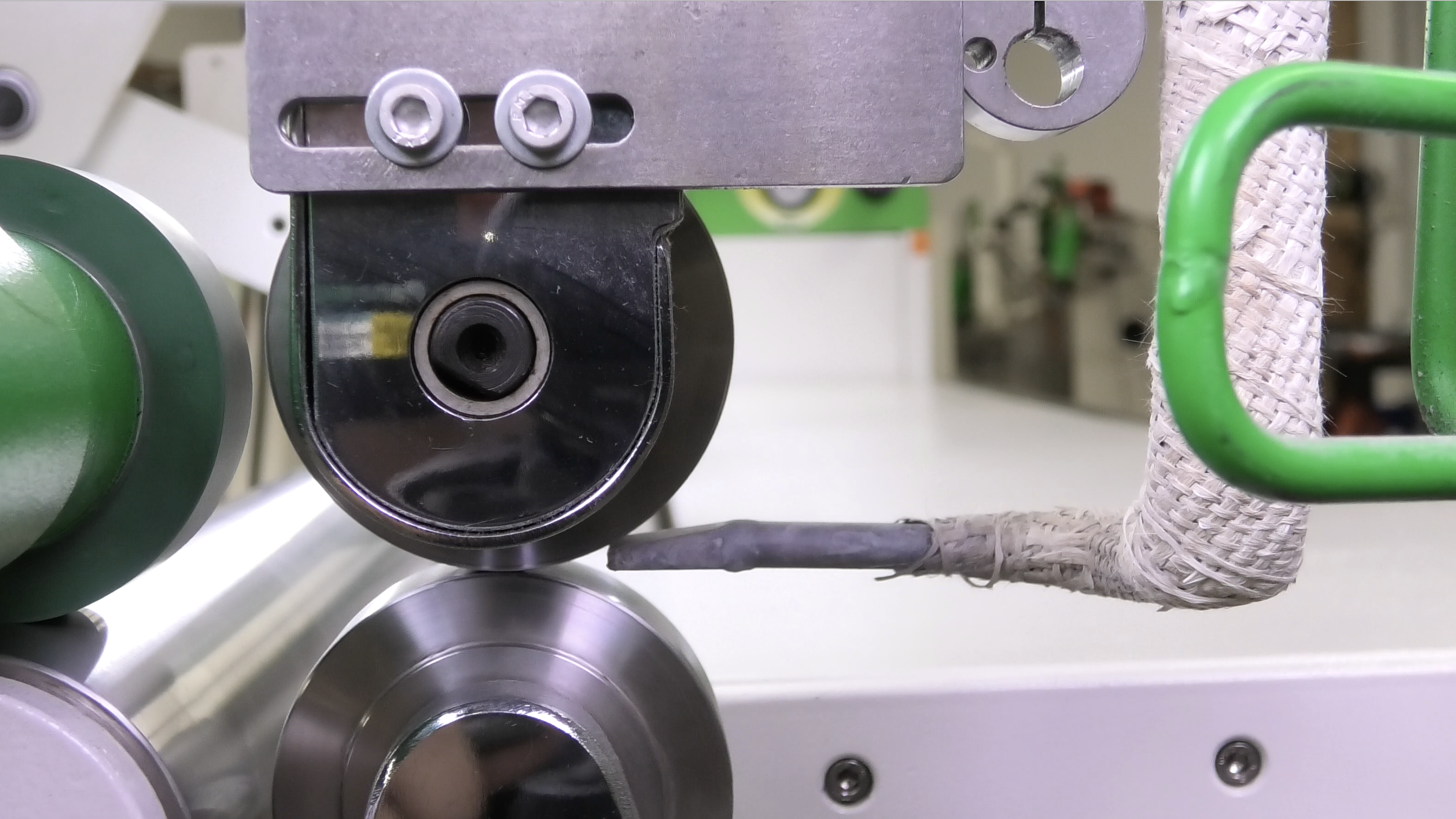
A hot air welding machine joins thermoplastic fabrics and films with heat, pressure, and motion. A heater warms the air, a nozzle blows it between two overlapping layers to melt their surfaces, and pressure rollers press the layers together so they fuse into one seam as they cool. The machine moves the material steadily along the seam so every inch gets the same heat, speed, and pressure.
For a step-by-step look at the process and the materials it welds, see our guide to how hot air welding works.
Main Components
- Heater: Raises the air to the set welding temperature.
- Nozzle: Directs hot air precisely between the layers. The nozzle width sets the weld width.
- Pressure rollers: Press the melted surfaces together right behind the nozzle.
- Drive system: Moves the material through the machine at a steady speed.
- Controls: Let operators set and save temperature, speed, and air volume for each material.
Dual Chamber Heat System
Miller Weldmaster's Dual Chamber Heat System, available on the T300 and T600, heats the air in two separate chambers before it reaches the nozzle. That keeps the welding temperature more consistent and helps prevent overheating or warping the material.
- Lower energy use: Better heat control means less electricity to hold the welding temperature.
- Quieter operation: The system runs quieter than a standard heat system.
- Longer part life: Less thermal stress on components means less wear, fewer breakdowns, and lower maintenance costs.
Benefits of Hot Air Welding Machines
- Strong, watertight seams: Welding fuses the layers instead of stitching through them, so seams are watertight and airtight. With traditional sewing, the fabric fails before a welded hot air seam.
- Faster production: Hot air welders work faster than sewing or taping and run continuously with repeatable settings.
- No consumables: No thread, glue, or tape to buy, and less material waste.
- Gentle on materials: Heated air softens only the surfaces being joined, so the rest of the fabric keeps its strength and appearance.
- Ready for automation: Unwinds, rewinds, and material guides can be added as production grows.
- Versatile: One machine can weld many thermoplastic materials and seam types, on curves as well as long, straight seams.
Hot Air Welding for Vinyl and Thermoplastics
Vinyl (PVC) and other thermoplastics soften when heated and harden again as they cool, which makes them ideal for hot air welding. The weld becomes part of the material itself, creating a clean seam without adhesives or stitching.
Banners and Signs
Hot air welding is widely used in banner production for hems, pole pockets, and joining panels. It produces smooth, continuous seams that hold up to outdoor exposure and frequent handling, and it is faster than taping or sewing. Sign shops rely on banner welding machines for both short and long production runs.
Tarps and Covers
Welded tarps and covers resist wind, rain, and sun better than stitched ones because there are no needle holes for water to get through. Automated systems keep seam quality consistent across large panels and high volumes.
Structures gonflables
Inflatable games, tents, safety devices, and boats need airtight seams that hold pressure. Hot air welding produces consistent, repeatable seams on curves and complex shapes—see our inflatable product welding solutions.
Thermoplastic Films
Hot air welding also handles many thin-gauge films, including polyethylene (PE), polyurethane (PU), and PVC. These films are common in packaging, industrial liners, vapor barriers, and signage.
Temperature and Settings
The right temperature depends on the material, its thickness, seam width, and welding speed. Start from your machine's material settings and always test on a sample before a full production run.
Comment choisir la bonne machine à souder à air chaud ?
The right machine depends on what you make, how much you make, and where you weld. Work through these questions before you compare models.
What Materials Will You Weld?
Different thermoplastics respond differently to heat. PVC-coated fabrics, polyurethane, polyethylene, and polypropylene each need their own settings, so choose a machine with precise temperature control and settings you can save for each material. If you mainly weld PVC and vinyl films, compare our vinyl welding machines.
Which Seams and Seam Widths Do You Need?
List the seams your products use—overlap seams, hems, hems with pockets, keder, butt seams, or webbing reinforcements—and the weld widths you need. Some machines weld several seam types, and some weld more than one seam at a time. Swappable nozzles make it easier to change seam widths.
How Much Do You Produce?
Entry-level and compact machines suit small shops, prototypes, and custom work. Industrial machines are built for long shifts, wide-format materials, and high-speed production, and can add automation such as unwinds, rewinds, and material guides. If your volume will grow, plan for it now to avoid an early upgrade.
Do You Need to Weld on Site?
Stationary machines handle production-floor work. Handheld hot air welders are made for repairs, installations, and field work, such as fixing a tarp at a job site or sealing roofing seams during installation.
Which Features Matter Most?
- Digital temperature, speed, and air volume controls
- Saved settings for each material and seam
- Buses interchangeables pour différentes largeurs de couture
- Laser guides or seam tracking for straight, consistent seams
- Automation options such as unwinds, rewinds, and material guides
- An efficient heat system, such as the Dual Chamber Heat System
What Training and Support Come With It?
Even the best welder depends on its operator. Look for hands-on training, clear documentation, fast technical support, and a supplier who can help you choose the right machine for your operation.
Once your welder is running, regular hot air welder maintenance keeps seams consistent and extends machine life.
Quand le soudage à l'air chaud est-il le bon choix ?
Hot air welding is one of the most versatile ways to join industrial fabrics. It is a strong fit when:
- You need fast, repeatable seams: Settings can be saved and reused, so seam quality stays consistent across high-volume runs.
- Stitching isn't waterproof or durable enough: Welded seams are watertight and airtight, and hold up to UV, weather, and chemicals better than thread.
- You weld large products with long seams: Truck tarps, curtain sides, banners, pool liners, and tent structures all need long, well-aligned seams.
- You need to weld in the field: Handheld welders make repairs and installations possible without a production setup.
For long seams on large panels, see our tarp welding machines.
Hot air isn't always the best fit. For thick or heavily coated materials on long, straight seams, hot wedge welding may be faster. For high-volume, airtight seams in PVC or PU, radio frequency welding is often the better choice.
Hot Air Welders From Miller Weldmaster
Miller Weldmaster has built industrial fabric welding machines for more than 50 years. Two hot air options cover most shops:
- T300 Extreme Flex: A versatile hot air and hot wedge welder for banners, tarps, inflatables, and more, with flexible seam widths, multiple welding heads, and touchscreen controls.
- EliteAir hand tool: A handheld hot air welder for in-house or in-the-field repairs of industrial fabrics, with a fast warm-up and a lightweight, balanced design.
Not sure which machine fits your products? Talk to a Miller Weldmaster expert about your materials and production goals.
Guides connexes
- Hot Air vs. RF Welding
- Hot Wedge Welding vs. Hot Air Welding
- Soudage à l'air chaud pour les structures gonflables
- How to Clean Hot Air Welding Nozzles
- Adjusting Hot Air Welders for Temperature and Humidity
- Comment choisir un système de soudage de tissus en 2026
Frequently Asked Questions About Choosing a Hot Air Welding Machine
What should I look for in a hot air welding machine?
Start with the materials you weld, the seam types and widths you need, and your production volume. Then compare controls, saved settings, nozzle options, automation, portability, and the training and support that come with the machine.
What is the difference between automatic and handheld hot air welders?
Automatic hot air welders are built for high-volume, consistent seams on the production floor. Handheld welders offer mobility and flexibility for repairs, installations, and small jobs.
Quelle température dois-je utiliser pour souder du vinyle à l'air chaud ?
The right temperature depends on the material, its thickness, seam width, and welding speed. Start from your machine's material settings and always test on a sample before a full production run.
Can hot air welding machines weld thermoplastic films?
Yes. Hot air welding handles many thin-gauge films, including polyethylene, polyurethane, and PVC, which are common in packaging, industrial liners, vapor barriers, and signage.
Puis-je souder ensemble différents types de tissus thermoplastiques ?
It depends. The fabrics need similar melting points and compatible surface chemistries to bond. Test the combination on a sample before production.
What is a dual chamber heat system?
Miller Weldmaster's Dual Chamber Heat System heats the air in two separate chambers before it reaches the nozzle. It keeps the welding temperature more consistent, uses less energy, runs quieter, and reduces wear on components. It is available on the T300 and T600.
Ai-je besoin d'une formation pour utiliser une soudeuse à air chaud ?
Yes. Many hot air welders are easy to use, but training helps operators set up materials correctly, weld safely, and get consistent seams. Miller Weldmaster provides training for its customers.
Quand le soudage à l'air chaud n'est-il pas la meilleure solution ?
For thick or heavily coated materials on long, straight seams, hot wedge welding may be faster. For high-volume, airtight seams in PVC or PU, radio frequency welding is often the better choice.